
A Parent’s Guide to Kindergarten Readiness
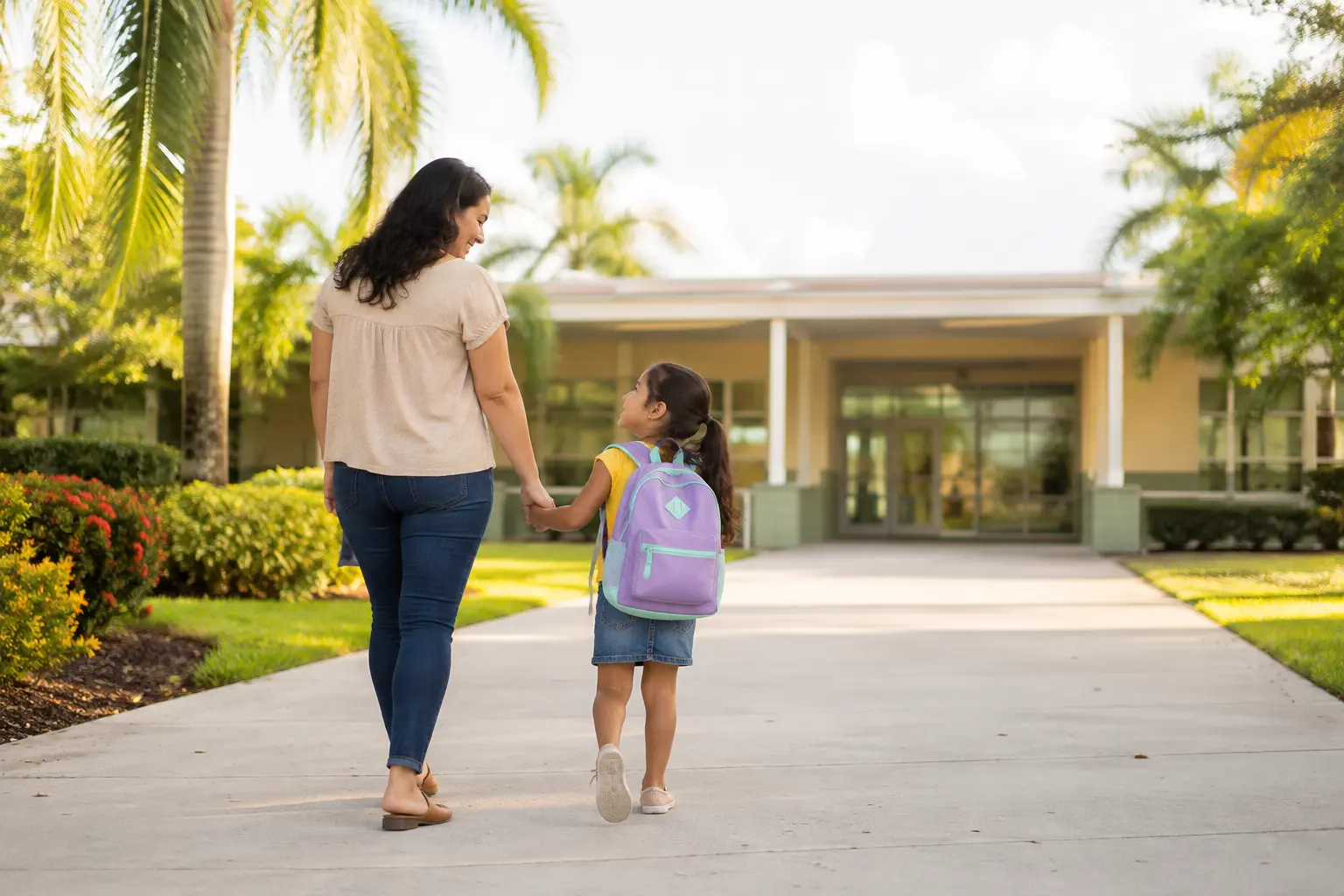
For generations, parents of young children have faced an age-old dilemma: Is my five-year-old ready for kindergarten? Would it be better to hold them back?
Because kindergarten is not mandatory in Florida, parents can delay kindergarten without having to prove a developmental or medical reason. The law states that a child who is five years old on or before September 1 is eligible for kindergarten that school year. Compulsory school attendance in Florida doesn’t begin until age 6 or for children who turn 6 by February 1 of that school year.
However, “parents should be aware that while they may technically hold back their child until age 6, most Florida public schools will still require kindergarten completion prior to first grade,” says Sarah M. Sukkar, M.D., a pediatrician at the University of Miami Health System. “Delaying just means the child starts kindergarten a year later, not that they can ‘omit’ it altogether.”
Nevertheless, as the curriculum for kindergarten becomes more academic, parents continue to worry about pushing a child into a formal classroom before he is ready.
The decision must be made in a narrow window of time. Once that child turns 6 or has already completed kindergarten, the school district usually won’t allow the child to repeat simply because the parents want to “redshirt” him.
“It’s fairly common for parents to worry,” adds Dr. Sukkar, who is also the lead pediatrician for the School Health Initiative at UHealth “The questions they ask [themselves] is universal: Did I do everything to get my kid ready?”
Parental doubt also creeps in because kindergarten is “an emotional milestone, a separation, and you want everything to be right. It’s a big weight.” She makes it a point to tell parents that the answer to the readiness question varies from child to child. There’s no one size-fits-all solution.
Concern about kindergarten readiness is not a pointless worry. When a child starts school already off track, “it places an invisible weight on our education system, our economy, and our talent pipeline,” according to The Florida Chamber Foundation’s 2025-2026 Kindergarten Readiness Report.
A child who is ready for kindergarten is “more likely to read proficiently by third grade, more likely to graduate on time, more likely to enter postsecondary education or the workforce with the skills they need.” More than an education metric, kindergarten readiness turns out to be one of the earliest indicators “of whether a region is on track to meet its long-term workforce goals.”
Yet, the foundation’s report found that more than half of the state’s youngest students entered kindergarten without meeting readiness benchmarks.
Only 44% of the kindergarteners in the fall of 2025 were considered ready to learn under Florida’s standards.
The gap between counties varied widely, which is another cause for concern. For example, in St. Johns County in northeast Florida, 58% of kindergartners met readiness benchmarks, but only 13% did so in Jefferson County in the Big Bend region. Miami-Dade (43%) and Monroe counties (42%) were slightly below the statewide average, while Broward (45%) and Palm Beach (44%) were similar to the statewide average.
That said, parents sometimes fret about the wrong benchmarks. In a world growing increasingly competitive, they may double down on ensuring their preschooler knows his numbers, letters and colors.
“But it’s more than academics,” Dr. Sukkar says. “Emotional and behavioral skills are just as important for school success. Parents need to be asking themselves: Is my kid in a good position to accept learning? Has he or she had his vision and hearing checked? Can he toilet alone?”
The good news is that there’s plenty of information and advice on the subject, so there’s no need for parents to make that hard decision without support.
If you or someone you know is considering holding a child back, Dr. Sukkar says:
Speak to your pediatrician about your child’s readiness.
A child’s doctor has a firm grasp of the benchmarks for speech, language, motor skills and toilet readiness for a 5-year-old. “You don’t have to do this alone,” she adds. “It’s a joint decision you can make with your pediatrician.”
Consult your child’s preschool teachers.
They spend a lot of time with your child in a classroom setting and can provide an objective assessment of his or her social, emotional or behavioral readiness. At home, reinforce what they’ve learned in preschool – the correct way to hold scissors, for example, or following two-step directions.
Check the many kindergarten-benchmark lists published by experts.
For example, the American Academy of Pediatrics’ Healthy Children.org provides evidence-based tips on preparing your child for school. Countdown2k, a mobile app that serves as a resource for parents and caregivers, has a series of informative YouTube videos to guide families, and the non-profit National Association for the Education of Young Children has a website full of helpful articles on early education. The Child Mind Institute also has a variety of information for families navigating the decision.
Begin school-readiness prep early, long before the first day of kindergarten.
At home, focus on impulse control and emotional regulation, on sharing and taking turns, following directions, and communicating. Ask — and honestly answer — these questions posed by Dr. Sukkar:
- Is the child fully toilet-trained? (This includes the ability to wipe and wash hands independently.)
- Is he or she self-sufficient in eating, dressing and other lifestyle-related tasks? (This means opening a lunchbox, peeling wrappers and eating independently.)
- Does he speak in full sentences?
- Can she communicate her needs?
- Does she listen?
- Does he get along with other children?
- Can she walk, run, hold a pencil and crayon like other 5-year-olds?
Assess a child’s language skills.
Can they recognize basic letters and shapes? Do they know how to hold a book and turn pages? Can they count to 10? Can they identify basic colors? Do they know their first and last names?
Enroll your child in the state’s Voluntary Prekindergarten (VPK) program.
This free educational program prepares 4-year-olds for success in kindergarten and beyond. The Florida Chamber Foundation readiness report found that preschoolers who completed VPK were “significantly more likely to be kindergarten ready.”
Use Florida’s Department of Education benchmark guides.
The Benchmarks for Excellent Student Thinking (B.E.S.T.) Standards is a home guide for language prep. There is also a parent guide for mathematics.
If your child doesn’t check off all the benchmarks, don’t lose hope. Children develop social and academic skills at different ages, just as they learn how to walk or talk at different times. And schools are structured to provide help for these varying skills. Florida law requires kindergarten screening within the first 30 days of school. This screening helps teachers plan how they can best meet a child’s needs while also communicating those findings to parents.
“There’s no hard and fast academic topic a kindergartner should know,” Dr. Sukkar says. “School is for teaching those. What’s important is the aptitude and readiness for learning.”
Written by Ana Veciana-Suarez and reviewed by Sarah M. Sukkar, M.D., a pediatrician at the University of Miami Health System.
Tags: Dr. Sarah M. Sukkar, kindergarten readiness, pediatric mental health, pediatric psychology

