
Can a New ALS Drug Slow or Prevent Lou Gehrig’s Disease?
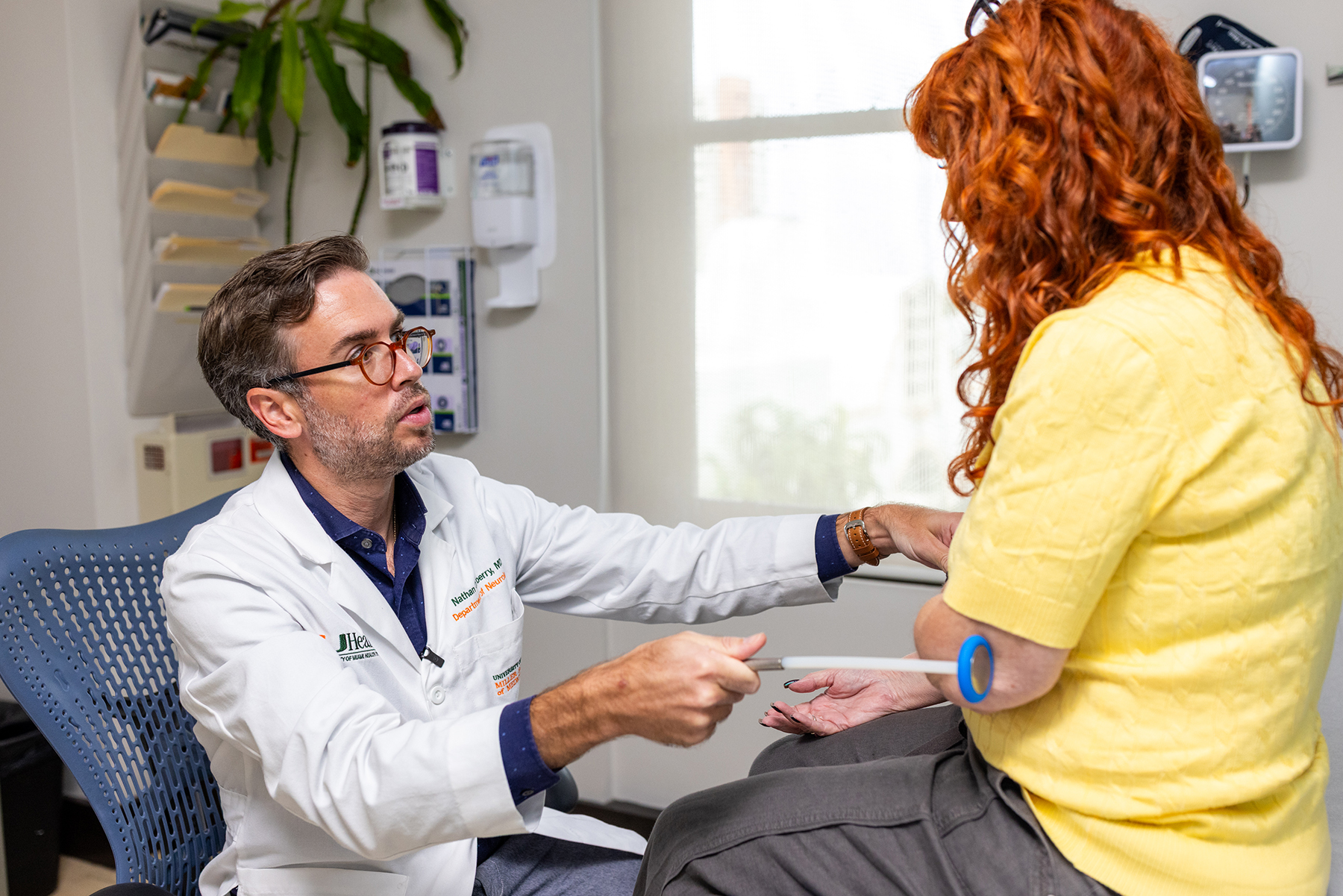
A new drug is offering hope for patients who have a genetic form of amyotrophic lateral sclerosis (ALS), commonly known as Lou Gehrig’s disease. In addition to dramatically slowing and, in some cases, stabilizing symptoms in patients with ALS due to mutations in the superoxide dismutase (SOD1) gene, tofersen is now being tested to evaluate whether the drug can actually prevent or delay the onset of SOD1-ALS.
“It’s an enormous boost for the ALS field because it is the first time we are seeing patients with any form of ALS improve,” says Michael Benatar, M.D., Ph.D., a neurologist at UHealth—University of Miami Health System. “Now we know, if we can target the root cause of disease, that ALS is treatable.”
Who Can Benefit From This New ALS Drug?
About 30,000 Americans are living with ALS, according to the National ALS Registry, and about 10,000 new cases are diagnosed each year. The average survival is two to five years from the onset of symptoms. Twenty percent live longer than five years.
People with ALS gradually lose their ability to walk, write, speak, swallow and breathe on their own. There is no cure, and approved drugs have only been able to marginally slow the damage to motor neurons in the brain and spinal cord.
Tofersen has changed that, says Dr. Benatar, the executive director of the University of Miami ALS Center. It works by reducing the production of a misfolded, toxic protein caused by a mutation in the SOD1 gene, accounting for about 2% of all ALS cases.
Tofersen, known by its brand name of Qalsody, was awarded accelerated approval by the U.S. Food and Drug Administration in 2023 in part because of its effects in lower levels of neurofilament, a protein that reflects neuronal injury in ALS.
Tofersen infusions have been shown to reduce spinal fluid concentrations of the mutant SOD1 protein that causes this particular form of ALS. It also lowers levels of neurofilament light (NfL) that mark ongoing nerve damage.
How the University of Miami Is Advancing ALS Research
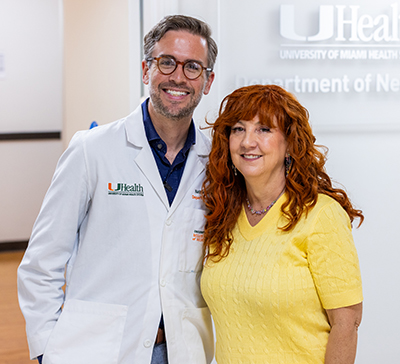
Shortly after the drug’s approval, UHealth established the Qalsody Clinic, one of a growing number of sub-specialty clinics at the UM ALS Center.
Led by UHealth neurologist Nathan Carberry, M.D., it was one of the first in the country to offer tofersen infusions and has active clinical trials for patients with ALS caused by the SOD1 mutation.
Dr. Benatar and the UM ALS Center participated in the VALOR clinical trial (Phase 3) that tested tofersen in symptomatic SOD1‑ALS patients. But Dr. Benatar has been studying presymptomatic ALS for decades. In 2007, he and Joanna Wu, Sc.M., associate director of research at the ALS Center, launched the Pre-Symptomatic Familial ALS (Pre-fALS) study that follows people with genetic mutations in SOD1, as well as many other genes that increase their risk of developing ALS. The Benatar-Wuu team published a study that revealed NfL levels in the blood go up even before symptoms in unaffected people who carry an SOD1 mutation.
Preventing or Delaying ALS
Dr. Benatar has partnered with Biogen, the maker of Qalsody, to design and lead ATLAS, a clinical trial that is testing if tofersen can prevent or delay the onset of ALS in SOD1 carriers if given early enough.
“In ALS, as in other diseases, the earlier you treat, the better the outcome,” Dr. Benatar explains. “That’s why it’s so important to intervene early on.”
Tofersen, Dr. Benatar adds, is an important breakthrough in the treatment of ALS. Now the focus is on figuring out the optimal timing of treatment and whether prevention might be possible.
Though the use of the drug “is still in the early stages,” Dr. Benatar says, he is hopeful that the science behind “can serve as a useful tool to develop similar treatments for other genetic diseases.”
Written by Ana Veciana-Suarez. Medically reviewed by Michael Benatar, M.D., Ph.D.
Sources
https://www.tandfonline.com/doi/full/10.1080/21678421.2024.2447919
https://www.miami-als.org/patient-care/UHealth
https://doi.org/10.1002/ana.25276
https://clinicaltrials.gov/study/NCT04856982
Tags: ALS research, Dr. Michael Benatar, Dr. Nathan Carberry, Lou Gehrig's disease treatment, neurology, prevent ALS

