Thriving Through Brain Cancer with Clinical Trials

When Mike Hugo woke up in a hospital in April 2022, he knew something was seriously wrong.
As a longtime salesman of medical devices, Hugo had seen his share of X-rays and MRI scans, so he asked to see his file. He quickly saw four compression fractures in his spine, the result of the car crash that landed him in the hospital. But as he kept scrolling, he saw something far scarier.
An MRI of his brain revealed a tumor the size of a golf ball. Hugo was told he suffered a seizure while driving home from a work event, lost consciousness and went into a ditch. The tumor would explain that.
Hugo huddled with his wife to figure out their next move. They wanted to find the best team possible to remove the glioblastoma growing in his brain. For them, that meant finding a team with access to a wide range of clinical trials to take advantage of the latest methodologies, technologies and research used to treat his complicated, hard-to-reach cancer.
Choosing the right team
“I had access to anyone in the world, so I chose the Tom Brady of neurosurgery,” Hugo said, referring to the team at Sylvester Comprehensive Cancer Center, part of UHealth – University of Miami Health System, and the only National Cancer Institute (NCI)-designated cancer center in South Florida.
A few days later, Hugo was at Sylvester starting a medical journey that included a surgical technique that was part of one clinical trial, a followup series of targeted radiation treatments that were part of another clinical trial and a wearable recovery aide that was approved by the U.S. Food and Drug Administration (FDA) after a successful clinical trial that UM participated in.
A multi-phase treatment plan
Those with glioblastoma typically receive a prognosis of little more than a year after diagnosis, but now, more than three years after his surgery, Hugo is alive and thriving. The adrenaline junkie has caught a sailfish from a kayak off Boynton Beach, ridden horses with his wife and two daughters through Yellowstone National Park and won a pistol-shooting competition at the Buffalo Bill Center of the West in Cody, WY. He even convinced country star Tim McGraw to sing a song on camera together in what became a viral video dedicated to Hugo’s daughters in case he’s not around for their wedding days.
Living life fully
In each case, Hugo sends photos and videos to his doctors at Sylvester to show them what they’ve allowed him to do. “They love it. I send them videos and ask, ‘How’s my KPS score?’” Hugo said with a laugh, referring to an assessment tool used to gauge a patient’s functional status.
Innovative surgery
The first step for Hugo was surgery to remove the tumor, which was performed by Michael Ivan, M.D., and Ricardo Komotar, M.D. When removing glioblastomas, surgeons usually remove only the tumor to avoid disrupting adjoining portions of the brain. Recent clinical trials have begun removing some of that surrounding brain matter if surgeons believe the cancer cells have spread and that section of the brain doesn’t affect basic motor and speech functions.
But Drs. Ivan and Komotar are participating in a clinical trial that goes deeper, more closely analyzing the function of each surrounding section of the brain (including those that control memory, emotion and spatial perception) to safely remove as many cancer cells as possible.
“The procedure went very smoothly,” said Dr. Ivan, director of research at Sylvester’s Brain Tumor Institute. “It’s just recently with new software that we’re able to take a much finer look at these subtleties of cognition that we weren’t able to before.”
Targeted radiation
The next step was radiation therapy. Glioblastomas regrow very quickly, so doctors use targeted radiation to minimize their growth. Traditionally, oncologists take an MRI of the brain and use that one scan to guide them through 40 days of targeted radiation. But Hugo’s team turned to Eric Mellon, M.D., Ph.D., who was participating in a clinical trial that takes a new MRI each day to see real-time changes in the tumor and target the radiation as it shifts. “They were chasing my tumor,” Hugo said.
A wearable breakthrough
The final phase of his treatment has been a wearable cap lined with magnets that create Tumor Treating Fields (TTFields) – electric fields that help slow down cancer cell division. The cap, called Optune Gio, was approved by the FDA following years of testing at Sylvester and other sites. Hugo has been so impressed with the results that he wears the cap nearly 24 hours a day. “I was fly fishing with it the other day,” Hugo said.
The power of a personalized plan
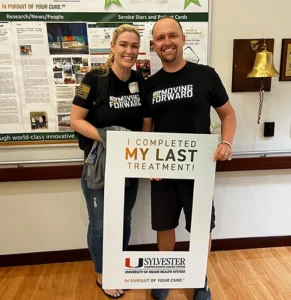
Put together, Hugo’s surgery, recovery and return to his life have shown the power of an expert team developing a comprehensive, personalized treatment plan that includes a wide range of clinical trials. “The Sylvester Brain Tumor Institute provides the most cutting-edge clinical trials in the country, giving our patients the best chance at a cure and advancing our understanding of brain cancer,” said Dr. Komotar, co-director of surgical neurooncology at the institute.
As he’s recovered, Hugo has become an advocate for cancer patients, including trips to Washington, D.C., to lobby government officials to allow more patients access to the kinds of clinical trials that saved his life. Back at Sylvester, his doctors continue monitoring his recovery, marveling at his energy and his eagerness to help others.
Advocacy and hope
“It makes me so happy to see him enjoying his family and his life,” Dr. Ivan said. “He’s inspiring a lot of patients who have brain cancer and really giving them hope, giving them someone to look up to. And he’s bringing attention to this disease process and the need for more funding to push the field further.”
Written by Alan Gomez for Sylvester Comprehensive Cancer Center.
Tags: Brain cancer research, Dr. Michael Ivan, Dr. Ricardo J. Komotar, Medical trials and advancements, Patient success stories, Sylvester Comprehensive Cancer Center

