
Lung Cancer: Advances in Early Detection and Surgery
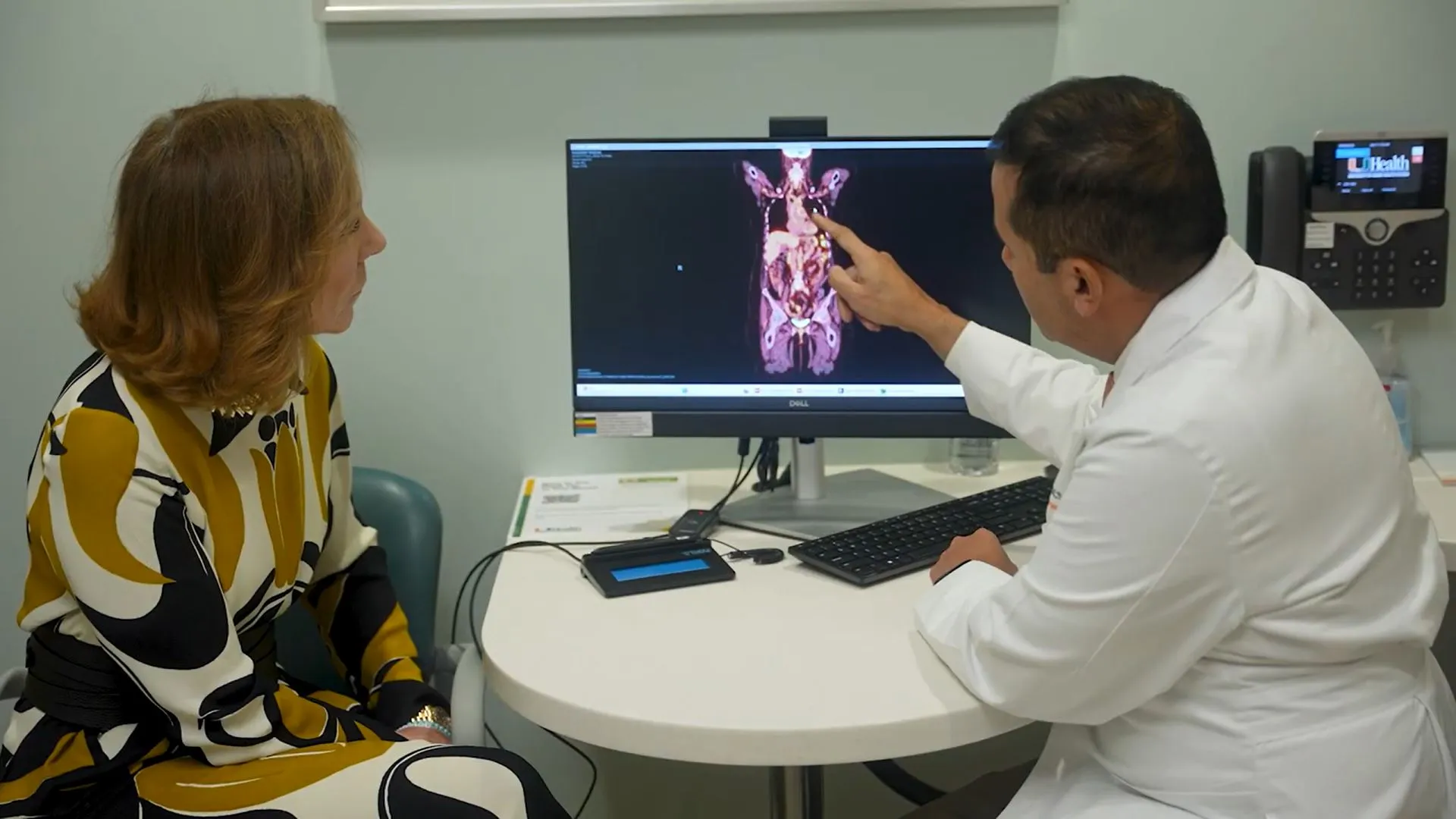
Lung cancer no longer affects only people who smoke. Doctors are diagnosing more cases in women and in people who have never smoked, often before symptoms appear.
Carmen Alvarez is one of them.“No one smokes in my home. No one ever has. My mother never smoked,” she says.
[SPANISH VERSION]
Diego Mauricio Avella Patino, M.D., a thoracic surgeon at Sylvester Comprehensive Cancer Center at UHealth Doral Medical Center, warns that dangerous misconceptions about lung cancer still persist.
“Lung cancer is very common among nonsmokers,” explains Dr. Avella-Patiño. “There is a common misconception that it only affects smokers, but between 20% and 30% of patients diagnosed with lung cancer have never smoked.”
The causes are not always clear. Environmental pollution, exposure to secondhand smoke, naturally occurring minerals such as radon, and genetic factors may all play a role. The impact on women is particularly significant.
“Lung cancer is the second most common cancer in women after breast cancer, but each year in the United States, more women die from lung cancer than from breast cancer,” adds the specialist.
For Carmen, the lung cancer diagnosis was unexpected.
“I slipped, got hurt, and went to the emergency room because I was having trouble breathing. I thought I had broken a rib, but a CT scan revealed a lung nodule,” she recalls.
Years earlier, doctors had identified a small nodule, but because she had no symptoms, she did not pursue follow-up care.
“It never bothered me, so I never went back,” Carmen says. “It was the same nodule, in the same spot, but it had grown. The whole thing felt like a miracle. If I hadn’t fallen, I never would have had that scan, and the cancer might not have been found in time.”
Sylvester Comprehensive Cancer Center’s Lung Nodule Program addresses cases like Carmen’s by ensuring that patients receive appropriate follow-up care for incidental findings.
Sylvester’s lung nodule program helps ensure that incidental findings receive proper monitoring and evaluation.
“Our goal is to make sure no lung nodule is ignored,” says Dr. Avella-Patiño. “All lung cancers begin as nodules, although most nodules are not cancerous. With appropriate follow-up, we can detect disease at an earlier stage and offer potentially curative treatment.”
In Carmen’s case, physicians diagnosed a Stage 1 adenocarcinoma, allowing for early intervention and an excellent chance of cure.
“The likelihood of curing this cancer exceeds 90% when it is detected at this stage,” the surgeon explains.
Surgical treatment for lung cancer has advanced significantly in recent years.
Today, surgeons use robotic technology in more than 99% of these procedures.
“Robotic surgery provides greater precision, smaller incisions, faster recovery, and a quicker return to normal activities,” says Dr. Avella-Patiño.
In Carmen’s case, surgeons used an even more conservative approach known as a pulmonary segmentectomy, or lung-sparing segmental resection.
“This procedure removes only the segment of the lung containing the cancerous tumor along with a small margin of surrounding tissue,” he explains. “We can cure the cancer while preserving as much healthy lung tissue as possible.”
A segmentectomy is a less extensive anatomic resection than other lung cancer operations, such as a lobectomy or pneumonectomy. By preserving more healthy lung tissue, it also minimizes the impact on breathing capacity. While removal of half a lung can reduce lung function by as much as 25%, removing a single segment typically results in only a minimal decrease.
Advanced technology, available at only a limited number of centers nationwide, allows surgeons to perform this procedure with exceptional precision.
“We use specialized software to create a three-dimensional reconstruction of the lung,” says the specialist. “This allows us to plan the surgery with remarkable accuracy and helps patients better understand how much lung tissue will be removed.”
For Carmen, seeing the operating room was eye-opening.
“When I saw it, it looked like something out of science fiction. There were enormous screens, and everything was magnified,” she says. “But the most important thing was learning that they wouldn’t have to open my chest. They would make only a few small incisions, and that gave me peace of mind.”
“The thought of having part of my lung removed was very emotional for me. I spent two months hesitating,” she admits. “But I realized I was fortunate that the nodule was contained and that removing it before it grew larger was the best option.”
Just 10 months after surgery, Carmen has fully recovered.
“You have to stay active and practice breathing exercises so your lung can expand again,” she says. “I feel great. I have no problems breathing.”
Beyond the medical outcome, Carmen says the experience reinforced the importance of compassionate care.
“From the moment you walk into the hospital, the way people treat you is incredible. When you’re vulnerable, kindness matters.”
As Dr. Avella-Patiño points out:
“Not every lung nodule is cancer, but every lung nodule should be evaluated. Early detection makes all the difference.”
Story and video produced by Shirley Ravachi for “Cuidando Su Salud,” a health news series that regularly airs on Telemundo 51. For more stories like this, visit Sylvester Comprehensive Cancer Center’s YouTube channel.
Tags: Dr. Diego Patino, Early Detection of Lung Cancer, Lung Adenocarcinoma, Lung Cancer in Nonsmokers, Lung Nodules, Pulmonary Segmentectomy, Robotic Lung Surgery, Sylvester Comprehensive Cancer Center, Thoracic Oncology

