
Former Bodybuilder Finds Hope at Sylvester After a Brain Cancer Diagnosis
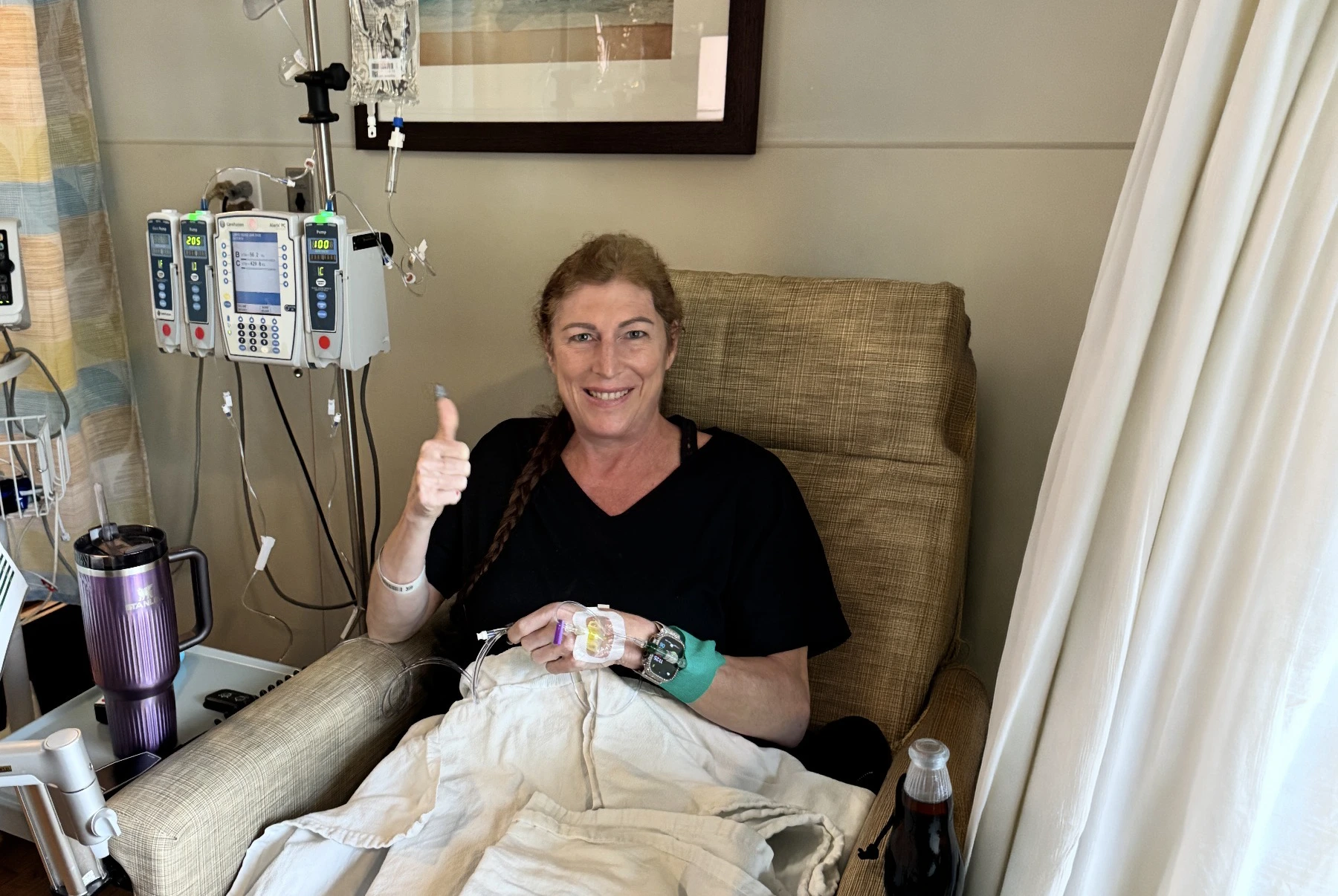
A leading-edge laser procedure at Sylvester and a multidisciplinary team approach to follow-up treatment have given the 50-year-old a new lease on life.
For Angela Keim, personal trainer and former bodybuilder champ, keeping fit and eating right have always been important pillars of her life. The 50-year-old was so interested in the field of wellness that she enrolled in New York’s Institute for Integrative Nutrition to earn her health coach board certification.
So, when the Bonita Springs, Fla., resident began suffering from headaches and fatigue, she wasn’t worried about her health. She chalked it up to menopause. Keim’s symptoms, however, turned out to be far more serious.
A shocking diagnosis
One day in June 2025, she was so exhausted that she lay down to nap. She woke up the next day in the intensive care unit of a Naples, Fla., hospital, unable to remember what had happened in the past 24 hours. There she found out that she had a glioblastoma brain tumor. Glioblastoma is a highly aggressive brain cancer that affects as many as 15,000 people a year in the U.S.
Her husband Roland and her physician friends urged her to transfer to Sylvester Comprehensive Cancer Center at the University of Miami, the only National Cancer Institute-designated center in South Florida. There she could seek the care of world-renowned neurosurgeon Ricardo Jorge Komotar, M.D., FAANS, FACS, who specializes in the field of brain tumors.
A precision laser approach to brain cancer
Keim was transferred to Sylvester on a Monday and on Wednesday underwent a leading-edge minimally invasive procedure known as Laser Interstitial Thermal Therapy (LITT). There are no statistics on how many of these are done every year, but the surgery is highly specialized and requires that neurosurgeons receive specific training.
“Dr. Komotar came very highly recommended, and he was amazing,” she says. “He fought to get me moved, and he made sure I received treatment right away. He has been so supportive throughout. He really saved my life.”
“LITT is the quickest and safest way to treat glioblastoma tumors, and it’s very precise,” explains Dr. Komotar. The technique compares favorably to the older type of brain surgery known as craniotomy. While craniotomy requires a substantial cranial opening, LITT uses a tiny burr hole (2 to 4 mm) that gives a surgeon enough space to maneuver and reach the tumor. The smaller cranial opening reduces wound-healing time, postoperative pain and surgical trauma.
Keim’s LITT procedure was actually performed inside an MRI scanner, which allowed Dr. Komotar to see the tumor and surrounding healthy tissue in real time. After drilling the tiny hole in the skull to get access to the tumor, he inserted a laser probe that uses thermal energy to target tumor cells. In addition, MRI thermometry maps allowed him to monitor temperature changes to ensure that healthy tissue outside the heat sphere of the laser tip remained below a damaging temperature threshold.
Keim says she is so “blessed” that Sylvester, one of the few centers that performs this specialized surgery, was within driving distance of her home.
“I felt so safe and protected the whole time I was there. I knew I was doing what I needed to do and I was doing it at the right place,” Keim says.
The power of a multidisciplinary team
Following surgery, she underwent six weeks of radiation treatment under the care of Markus Bredel, M.D., Ph.D., a radiation oncologist at Sylvester. “He’s not just a fantastic doctor but also such a good, caring human being,” Keim says of Dr. Bredel.
“Her tumor was so large that it was causing significant pressure on her brain, and our immediate goal was to stabilize her while giving her the best possible chance for meaningful recovery. Throughout treatment, she demonstrated extraordinary resilience and determination,” Dr. Bredel says.
Kiem also benefited from Sylvester Brain Tumor Institute’s (SBTI) multidisciplinary approach that brings together a team of neurosurgeons, neuro-oncologists and medical scientists. Under this team’s supervision, LITT is considered part of a comprehensive treatment strategy that includes radiation, chemotherapy and targeted drugs.
“At Sylvester, every patient benefits from a multidisciplinary team that includes neurosurgeons, radiation oncologists, neuro-oncologists, neuroradiologists, neuropathologists, rehabilitation specialists, nurses and supportive care experts who work together to develop a personalized treatment plan,” Dr. Bredel adds.
“That collaboration was especially important for Angela. Because every member of the team contributed their expertise, we were able to coordinate surgery, radiation therapy, systemic treatment and supportive care seamlessly. That level of integration gives patients the greatest opportunity to achieve the best possible outcomes.”
Keim’s treatment illustrates how the University of Miami Health System combines neurosurgery, radiation oncology, neuro-oncology and supportive care in a coordinated approach for patients facing complex brain cancers.
Finding purpose through recovery
During her stay at UHealth Tower, the flagship academic-based hospital of the University of Miami Health System, Keim fell back on the familiar: her daily exercise routine. Her husband, Roland, brought over dumbbells and a treadmill so she could exercise in her room, and she was often seen walking the hospital corridors, greeting staff and fellow patients.
“I need structure in my life,” she explains, with a laugh. “I’m not one to sit around. I need to do something with my days.”
After radiation, Keim was sent home and placed on immunotherapy and chemotherapy. At one point, however, she started feeling sick again. Her ears were buzzing, and she was nauseous. The headaches had returned. She ended up returning to the hospital, where Dr. Komotar tried a second LITT procedure. He determined it wasn’t possible to laser out any more tumor cells.
Back in her Bonita Springs home now, Keim keeps busy. She’s learning Spanish, playing piano again, and making plans to visit her family in Germany. She wants to use her experience to assist others through their cancer journey.
“This is something God gave me to conquer and to help others,” says Keim, who under her maiden surname, Beyer, won the 2009 Miss Florida, Miss USA and Miss Universe bodybuilding contests. “Getting rid of the cancer is my next competition.”
Written by Ana Veciana-Suarez. Reviewed by Ricardo Jorge Komotar, M.D., FAANS, FACS
Tags: brain cancer treatment, Dr. Ricardo J. Komotar, LITT procedure, multidisciplinary brain tumor care, Sylvester Comprehensive Cancer Center

