
School Burnout in Kids and Teens: Warning Signs and How Parents Can Help
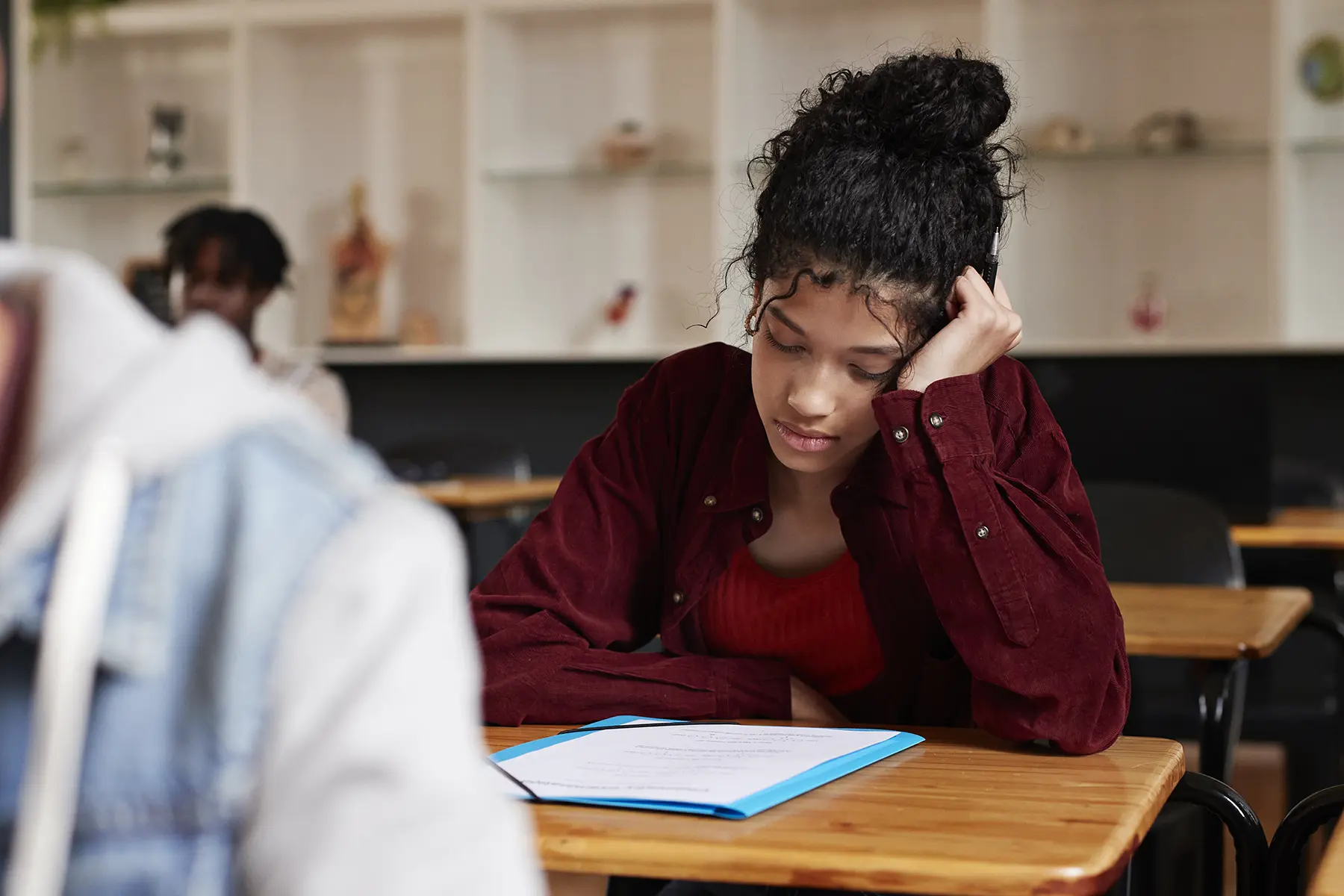
Burnout in the sports field or the corporate boardroom is a subject widely discussed, but most of us rarely hear about an equally concerning situation among youth. Yet, school burnout is real, and experts suggest parents be on the alert for the telltale signs.
“Students face the same kind of stressors we hear about in other fields,” says Elizabeth Pulgaron, Ph.D., a clinical psychologist with the University of Miami Health System. “Burnout is not limited to one area or profession.”
School burnout is not a temporary feeling of fatigue or a pressure that eases after a classroom deadline is met. Rather, “It’s an ongoing sensation that does not go away even after the student takes the big test or turns in the project,” Dr. Pulgaron explains. “These are students who can’t move forward. They can’t get over the hump. They end up asking themselves: Why am I even doing this?”
The ongoing state of exhaustion is triggered by continuous stress that depletes a student’s mental and emotional reserves. And it can lead even the most motivated of students to feel overwhelmed and helpless. It manifests itself in our bodies through headaches and stomachaches, changes in sleep patterns, irritability, lack of interest, and, in some unresolved cases, depression and anxiety.
Academic burnout is a lot more common than most parents imagine.
One market research company that draws its numbers from different primary and secondary sources has concluded that 38% of U.S. high school students report burnout (broadly defined as mental and emotional exhaustion). In addition, 42% of students report academic‑related distress (considered a burnout symptom) and 43% of high schoolers experience stress severe enough to interfere with daily activities at least once per year.
It’s not any better at the college level. The same marketing research company reported that 74% of U.S. college students say they felt moderate to severe emotional exhaustion due to academic stress in 2023. Not surprisingly, STEM majors report higher burnout than those majoring in the humanities. Minority and LGBTQ+ students also experience higher levels, as do first-year college students when compared to older individuals.
Female students are more likely to report burnout on all grade levels.
That doesn’t surprise Dr. Pulgaron, who also serves as director of Mental Health Services for UHealth’s School Health Initiative. “In general, girls and women internalize the message to be ‘perfect’.” They end up putting a lot of pressure on themselves.”
Experts note that the prevalence of student burnout has been inching up over the years as academic competition and structured extracurricular schedules have increased. The causes of burnout cited by students and researchers are not surprising, either: heavy academic loads, a competitive culture, high debt burden (in the case of college students) and limited mental health support for students. More recently, the amount of screen time has also come into play. Students who used social media more than 3 hours a day increased burnout risk by 2.5 times in teens.
Ultimately, however, it’s the make-or-break pressure of an entrance exam or the mentality that only a top college will do that accounts for most of the pressure. For example, the research firm Gitnux concluded that high-stakes testing pressure led to burnout in 73% of U.S. high schoolers, and academic workload is the primary cause of burnout in 82% of college students.
“Academic pressures are higher than they were in the past and the pressure starts at an early age,” Dr. Pulgaron notes. “Our students are taking more standardized tests, more state tests, and they’re taking them younger than ever.”
She says that reducing a student to a series of numbers or one score based on standardized tests can add unnecessary pressure to those who may not test well — or to those who believe they should score higher.
“When a child is constantly told by a number that they don’t measure up to some fixed norm, their self‑esteem inevitably suffers,” she says. “We have to remember that children develop on different timelines and have different strengths, and that’s perfectly fine.”
The demand for an impressive academic resume doesn’t allow for downtime.
A student who shines academically may also be urged to collect a string of stellar extracurricular activities to get into a top college. “All this pressure builds, and it ends up having a cumulative effect,” she adds. “Yet, we all need time to recover.”
So, how can a parent or educator spot a struggling student? Look for these signs:
- General irritability and cynicism
- Prolonged fatigue
- Fading motivation and problems concentrating
- Withdrawal from social activities
- Talk of being overwhelmed, particularly as it relates to what were once achievable tasks
- Loss of confidence
- A drop in grades and/or the inability to meet academic deadlines
- Headaches, stomachaches, or any kind of pain or tension in the body, such as in the jaw
- Trouble sleeping
- Getting sick more frequently
“You should look for any change in previous behaviors,” Dr. Pulgaron adds. “If they’re not behaving as they usually do, then it’s time to find out what’s going on.”
Burnout is both preventable and treatable.
In the simplest terms, it’s a case of imbalance: too much work within an unrealistic time setting. A college student may be taking more classes than she can handle, or the academic load of advanced coursework may be too much for a high schooler.
Data compiled by ZipDo’s Student Burnout Research paper suggests this: 92% of Advanced Placement and International Baccalaureate high school students report experiencing burnout by the end of the school year. Students also say too much homework contributes to their stress. In fact, the average high school student spends 3.5 hours per night on homework, which is a full two hours more than what the National Education Association recommends.
To help students cope with these increasing school demands, Dr. Pulgaron suggests parents begin to monitor their child’s behavior early in the academic year:
- Keep an open line of communication. “Talk to your child,” she says. “Ask, How is this going? How can I support you? You don’t want to be caught off guard.”
- Be willing to pivot and shift directions. “Not everything is for everyone. A parent should be asking themselves what is specifically best for their child.” In other words, what a parent wants or what is more prestigious may not be a good fit for the child.
- Stay involved with the school at the elementary, middle, and high school level. Teachers may be able to detect a change in behavior — a drop in grades, a lack of interest — in their classrooms. Be open to their suggestions.
- Look for both academic and mental health support for your child. Tutors, support groups, and time management programs may ease the transition to more rigorous academic work.
- Encourage your student to visit the school counselor or seek out an older student who might serve as a peer mentor if they’re struggling or simply want to vent.
- Help your student set realistic goals. “People eventually find their path, and for most that isn’t linear,” Dr. Pulgaron says. “It takes time to find our strengths.” Usually, that involves a lot of trial and error.
- Model time-management for your child. Help them prioritize tasks. Suggest reducing the academic workload. And teach them not to procrastinate.
- Make sure your child takes breaks for socializing and spending time outside. As the old proverb says, “All work and no play makes Jack a dull boy.”
Written by Ana Veciana-Suarez. Reviewed by Elizabeth Pulgaron, Ph.D.
Sources
https://gitnux.org/high-school-student-burnout-statistics
https://gitnux.org/student-burnout-statistics/#section-prevalence-rates
https://zipdo.co/high-school-student-burnout-statistics
Tags: academic burnout, academic stress in teens, high school burnout, how to help a burned-out student, parental support for school stress, school burnout prevention, school burnout symptoms, school stress, signs of school burnout, student burnout, student mental health, teen burnout

