Surgery Gave Him a Second Life: Complex Abdominal Aortic Aneurysm Treated at Comprehensive Aortic Center
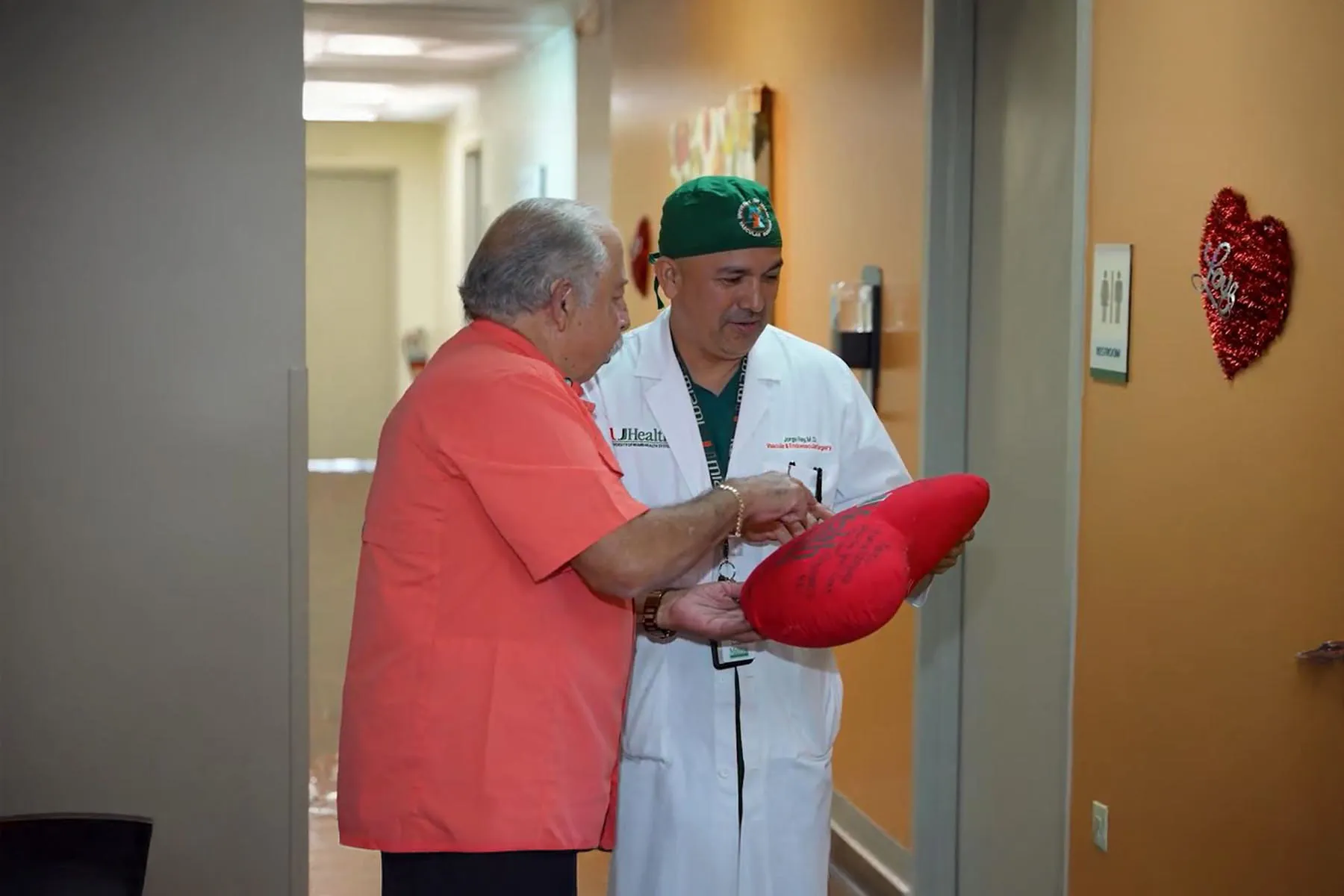
When Miguel Castillo was diagnosed with an abdominal aortic aneurysm (AAA or triple A), his world changed overnight. What he heard then was devastating: the procedure he needed was complex and, apparently, he had no options.
“I felt very depressed,” Miguel recalls. For a while, he lived with fear and anxiety. The uncertainty about his future left him with little hope.
Before arriving at UHealth, Miguel had visited other medical centers where he was told his aneurysm was not operable.
But everything changed when he met Jorge Rey, M.D., chief of vascular surgery at the University of Miami Health System – UHealth and associate professor of surgery with the UM Miller School of Medicine. “Unfortunately, sometimes patients are told there are no options,” says Dr. Rey. “But it’s always important to seek another opinion.”
UHealth’s Comprehensive Aortic Center provides coordinated, multidisciplinary care. The center brings together specialists in vascular surgery, cardiothoracic surgery, cardiology, advanced cardiovascular imaging, genetics, and endovascular therapies to develop individualized treatment plans for each patient.
Miguel’s story also reflects a broader advancement in the treatment of complex aortic disease, said Dr. Rey, noting that an aneurysm occurs when an artery weakens and expands beyond its normal size. In the case of the aorta—the main artery that carries blood from the heart to the rest of the body—this can become a life-threatening condition.
“The normal size of the aorta is usually between 2.2 and 2.8 centimeters,” says Dr. Rey. “When that artery grows to more than one and a half times its normal size, we call it an aneurysm.”
In most cases, aneurysms do not cause symptoms.
The problem is “many people don’t know they have one,” he says. “The risk is that the weak spot can keep growing and eventually rupture. When that happens, the probability of death can approach 75%.”
In Miguel’s case, the aneurysm was quite large and located near important arteries, including those that supply the kidneys, which made the case particularly complex.
The first appointment with Dr. Rey lasted nearly an hour and a half. For Miguel, that time was crucial. “We talked for almost 90 minutes,” he remembers. “Every time it seemed like the consultation was over, the doctor would ask, ‘Do you have any other questions?’ When I left that appointment, I had no doubt this was the place where I needed to have the operation. I felt calm, like I was talking to a brother.”
Dr. Rey and his team carefully reviewed the case using a multidisciplinary approach.
“We analyze the imaging, the patient’s medical conditions, and discuss the case with other specialists,” he says. “Sometimes the best option is a minimally invasive endovascular procedure, and other times open surgery is the best alternative.”
The complexity of Miguel’s aneurysm made an open procedure necessary to ensure the best long-term result. During the operation, something unexpected happened. In addition to the main aneurysm, the surgical team discovered two additional aneurysms developing.
“When we saw them during surgery, we decided to repair them right then and there,” says Dr. Rey. “We didn’t want the patient to have to go through another operation in the future.”
The surgery lasted more than six hours, and it was a success.
“Dr. Rey was like a quarterback in American football, making a decision at the line of scrimmage,” Miguel says with a smile. “He knew exactly what he was doing.”
Thanks to that decision, all of the aneurysms were repaired in a single procedure. The recovery was better than expected. According to Dr. Rey, Miguel even set a kind of record. “He was one of the patients who went home faster than we usually see for this type of surgery,” he says. “By the fourth day, he was already back home.”
Today, several years after the operation, Miguel looks back with gratitude. “Every time I see Dr. Rey, I hug him,” he says. “What he did for me is beyond words. I feel like I’m living another life. I’ve been able to enjoy wonderful years that I might not have had if I hadn’t had surgery with Dr. Rey.”
After the surgery, Miguel also made important lifestyle changes. He quit smoking and now focuses on maintaining healthier habits.
“The doctor told me that quitting nicotine was one of the best decisions I could make,” Miguel says. “Now I try to enjoy the food I like, but in moderation.”
Miguel’s story also reflects a broader advancement in vascular medicine.
“In recent years, technology has transformed the treatment of aneurysms. Today there are advanced endovascular devices—such as stents or grafts with special branches—that allow us to treat complex aneurysms that previously could only be treated with open surgery.”
But for Dr. Rey, technology is not the only important factor.
“The most important thing is not to see the patient as just an aneurysm,” he says. “It’s a person who is afraid, who will go through pain and a recovery process. Our job is to understand that and support them at every stage.”
For Miguel, the experience left a clear lesson: when someone receives a difficult diagnosis, it is always worth seeking a second opinion.
“If someone is told there is no solution,” he says, “they should look for another place, another doctor.” Because sometimes, as it happened in his case, that second chance can change everything. “For me,” he concludes, “it meant starting a new life.”
To learn more about UHealth’s Comprehensive Aortic Center, call 305-4-AORTIC (267842) or request an appointment online.
Article and video written and produced by Shirley Ravachi for “Cuidando Su Salud” (Taking Care of Your Health), a series of health stories regularly broadcast on Telemundo 51. For more stories like this, visit the UHealth YouTube channel.
Tags: abdominal aortic aneurysm, complex aortic disease, Comprehensive Aortic Center, Dr. Jorge Rey, open surgery, second opinions, vascular surgery in Miami

