Teen With Rare Synovial Sarcoma Keeps Her Leg After Complex Limb-Sparing Surgery
For 13-year-old Jada Anderson, aches and bruises came with life as a competitive cheerleader. As one of the team’s flyers, she spent practices soaring through the air and trusting her teammates to catch her. Pain was simply part of the sport.
So, when she began complaining of pain in her groin during practice in November 2024, no one thought much of it. Ice, stretching, and rest didn’t help. Then she told her mother she had found a lump.
Within weeks, an ultrasound, MRI and biopsy confirmed every parent’s worst nightmare.
Anderson had synovial sarcoma, a rare and aggressive soft tissue cancer that most often affects adolescents and young adults. The initial treatment plan included chemotherapy and the possibility of an amputation at the hip.
“I was petrified,” her mother, Amina Laurenceau, recalls. “It felt like my whole world stopped.”
Anderson’s response was remarkably different. Even after reading heartbreaking stories online, she was convinced she would have a positive outcome.
“Mom, I’m not scared,” she told her. “My cancer will not define me. My story will be different.”
That quiet determination carried her through the difficult months ahead.
After four rounds of chemotherapy left Anderson extremely ill and failed to shrink the tumor as much as hoped, her physicians began searching for another option. Saving her life remained the priority, but preserving her leg seemed increasingly unlikely.
The multidisciplinary team that saved her leg
Determined to explore every possible option, Anderson was referred to Sylvester Comprehensive Cancer Center, part of UHealth – University of Miami Health System, internationally recognized for treating complex sarcomas.
Orthopedic oncologist Erik Geiger, M.D., assembled a multidisciplinary team that included vascular surgeon Matthew Sussman, M.D., and plastic surgeon Natalia Fullerton, M.D.
“When we met the team, everything changed,” Laurenceau says. “For the first time since Jada’s diagnosis, I felt hope. I knew this was the medical team we were meant to be with.”
Together, they set out to accomplish something that initially seemed impossible: completely remove Anderson’s cancer while saving her leg.
“Historically, many extremity sarcomas were treated with amputation,” says Dr. Geiger, assistant professor of orthopaedic oncology, limb lengthening and complex reconstruction. “Today, advances in surgery and multidisciplinary care allow us to safely save the limb for many patients while still effectively treating their cancer.”
Because the tumor had completely encased the major blood vessels supplying Anderson’s leg, the operation required a level of expertise available at only a handful of centers.
“Children’s arteries are very small and delicate, and there are very few centers that routinely perform this type of reconstruction,” says Dr. Sussman, assistant professor of surgery.
During the more than 10-hour operation, the team worked seamlessly together. Dr. Geiger removed the tumor, Dr. Sussman restored blood flow to Anderson’s leg, and Dr. Fullerton rebuilt the tissue needed to protect the reconstruction and preserve the function of her leg.
The surgery was a success.
For Dr. Fullerton, Anderson’s case reflects the power of Sylvester’s multidisciplinary care.
“Every member of the team is involved from the very beginning,” says Dr. Fullerton, assistant professor of plastic surgery. “We plan together, anticipate each challenge together and perform the reconstruction together. That collaboration gives patients the best possible chance for a successful outcome.”
Saving more than a leg
Recovery wasn’t easy. But throughout weeks of rehabilitation, Anderson remained focused on one goal: getting back to cheerleading.
Just two months after surgery, she returned to school for the start of eighth grade. Before long, she was once again flying through the air with her competitive cheer team.
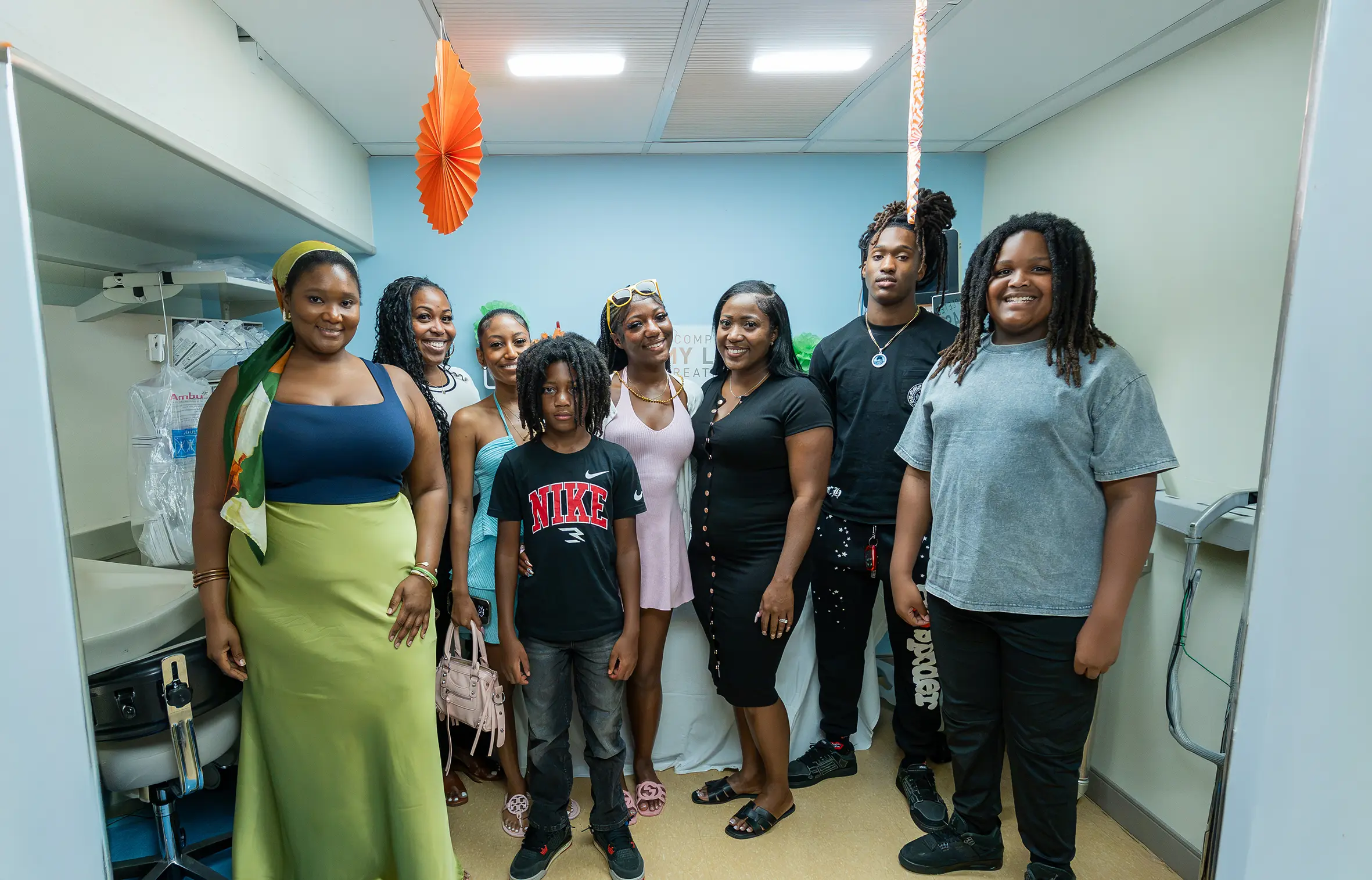
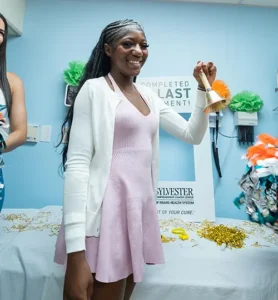
Her one-year follow-up scans showed no evidence of disease, and she recently rang the bell marking the completion of her cancer treatment, a milestone that once seemed unimaginable.
“It felt great to ring the bell,” Anderson says. “I am excited to finally be back at cheerleading and spending time with my friends.”
Although she will return to Sylvester for routine surveillance, cancer no longer defines her days. Instead, they are filled with school, friends and the sport she loves.
A message of hope
Anderson is sharing her story because she wants other families facing a diagnosis like hers to know there can be hope.
“I want people to know there are other options,” Anderson says. “I don’t want them to lose hope.”
Her mother agrees, encouraging parents facing a frightening diagnosis to stay off the internet, advocate for their children, ask questions and seek multiple opinions.
“Don’t settle for the first answer and make sure you understand all of your options,” she says. “There are amazing teams doing incredible things that many families don’t even realize are possible.”
She also reminds parents to care for themselves during the journey.
“Take a moment to breathe,” she says. “Lean on your friends and your family. And never forget that someone else’s story doesn’t have to become your child’s story.”
Today, Anderson is back where she belongs. She is flying through the air, chasing her dreams and proving that she was right all along.
Her story was different.
Written by Debby Teich. Reviewed by Erik Geiger, M.D., et al.
Tags: Dr. Erik Geiger, Dr. Matthew Sussman, Dr. Natalia Fullerton, Rare cancer treatment for adolescents, Sylvester Comprehensive Cancer Center, Symptoms of synovial sarcoma in teenagers, synovial sarcoma treatment

